Thomas Cirillo pays tribute to Kosti Manibe, hails his legacy of public service and economic stewardship
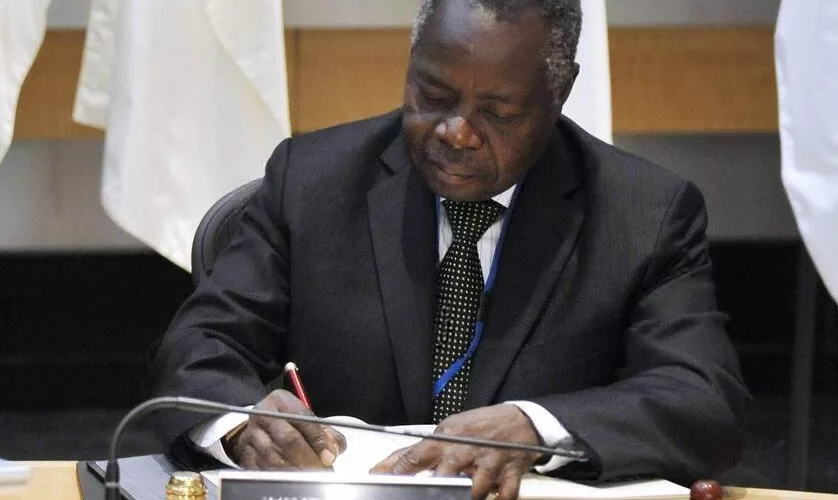
Hon. Kosti Manibe’s life has ended before the ideals he fought for have been fully achieved…
Gen. Thomas Cirillo Swaka, Chairman and Commander-in-Chief of the National Salvation Front (NAS), has paid tribute to Hon. Kosti Manibe Ngai, hailing the veteran statesman’s legacy of public service, integrity and economic stewardship, and describing him as one of the great sons of South Sudan.
Manibe died on August 11, 2026, in Nairobi, Kenya. In his condolence message, Gen. Cirillo extended sympathies to Manibe’s wife, Rev. Nydia Gune Wilson Lupai, his family, relatives and the wider people of South Sudan.
Gen. Cirillo paid particular tribute to Manibe’s character, describing him as having lived an “admirable and exemplary” life marked by humility, honesty, integrity and selfless service. The NAS chairman honoured Manibe’s foundational work with the Sudan Council of Churches and his significant contribution to the liberation struggle that led to South Sudan’s independence.
“Hon. Kosti Manibe’s life has ended before the ideals he fought for have been fully achieved,” Gen. Cirillo stated, calling on all South Sudanese to preserve his memory by upholding the character, moral values and dedication to public service that defined his political career.
Early foundations in public service
Before South Sudan’s independence, Manibe worked with the Sudan Council of Churches, where he was involved in humanitarian and public service work. His career later moved into the political and economic spheres, where he served in a number of public portfolios.
A key figure in South Sudan’s first economic years
Manibe became South Sudan’s Minister of Finance and Economic Planning following independence, serving from August 2011 to July 2013. His tenure coincided with one of the most severe economic crises faced by the newly independent country.
In January 2012, South Sudan halted its oil production following a bitter dispute with Sudan over oil transit fees and the alleged seizure of South Sudanese crude. Oil revenues had accounted for roughly 98 percent of government revenues, leaving the new country facing an immediate and profound fiscal crisis.
As finance minister, Manibe introduced a series of austerity measures aimed at keeping the government functioning during the oil shutdown. His ministry proposed major reductions in non-salary expenditure, tighter controls on government spending and measures to increase non-oil revenue.
He subsequently presented an austerity budget to Parliament for the 2012-13 financial year. The budget reduced government spending from the previous year and included cuts to foreign travel, bonuses, overtime and housing allowances. Manibe also urged Parliament to ensure implementation of the Public Finance Management and Accountability Act in order to strengthen transparency and fiscal discipline.
The economic pressure was severe. Contemporary reporting described the oil shutdown as a massive shock to the economy, with the government forced to draw down reserves, seek alternative financing and increase domestic revenue collection.
NAS’s condolence message therefore places Manibe’s economic stewardship within a period when the new Republic was confronting an unprecedented fiscal crisis. The movement credits him with helping keep the country’s economy functioning during that difficult period.
Helped establish South Sudan’s international financial institutions
Manibe also played a significant role in establishing South Sudan’s formal relationship with the international financial system.
On April 18, 2012, he signed the Articles of Agreement that formally admitted South Sudan as the International Monetary Fund’s 188th member. The IMF said the country faced enormous challenges and that it would support efforts to establish foundations for economic stability and growth.
Earlier that same year, Manibe signed a US$9 million World Bank grant agreement designed to expand access to finance, support entrepreneurship and create employment opportunities in South Sudan. The World Bank described the agreement as the first grant it provided to South Sudan as a sovereign state.
Manibe was also involved in efforts to reduce South Sudan’s dependence on Sudan’s oil-export infrastructure. In 2012, he publicly discussed plans for a proposed pipeline linking South Sudan’s oil fields to Kenya’s port of Lamu, estimated at the time to cost about US$3 billion.
A controversial removal that remained politically significant
Manibe’s tenure as finance minister ended in July 2013 after he was suspended by President Salva Kiir in connection with a financial scandal involving the alleged unauthorised transfer of nearly US$8 million for fire-safety equipment.
At the time, Manibe maintained that his suspension was politically motivated.
The subsequent investigation is significant. A United Nations report later recorded that the investigation found a basis for criminal proceedings against then-Cabinet Affairs Minister Deng Alor, but not against Kosti Manibe.
NAS’s condolence message characterises Manibe’s removal differently, stating that he earned the wrath of what it describes as the country’s “corruption cartels,” which it says engineered his removal from office. The movement presents his departure from government as part of the broader struggle between public integrity and entrenched corruption.
His political journey continued
Manibe remained involved in South Sudanese politics after leaving the finance ministry. He became associated with the Former Political Detainees, a group of senior SPLM figures detained at the outbreak of the December 2013 conflict.
In 2017, Manibe served as a spokesman for the group and publicly argued that the 2015 peace agreement had become severely fractured and had failed to bring lasting peace.
His political career thus extended beyond his time in government, reflecting his continued involvement in debates over South Sudan’s governance, peace process and political future.
For NAS, however, Manibe’s legacy is ultimately measured by his commitment to public service and the ideals he pursued throughout his life.
The National Salvation Front extends its deepest condolences to the family, relatives, friends and all those who mourn Hon. Kosti Manibe Ngai.
May his soul rest in eternal peace.