Bishop tells Pres Kiir to repent in pointed Good Shepherd Sunday sermon
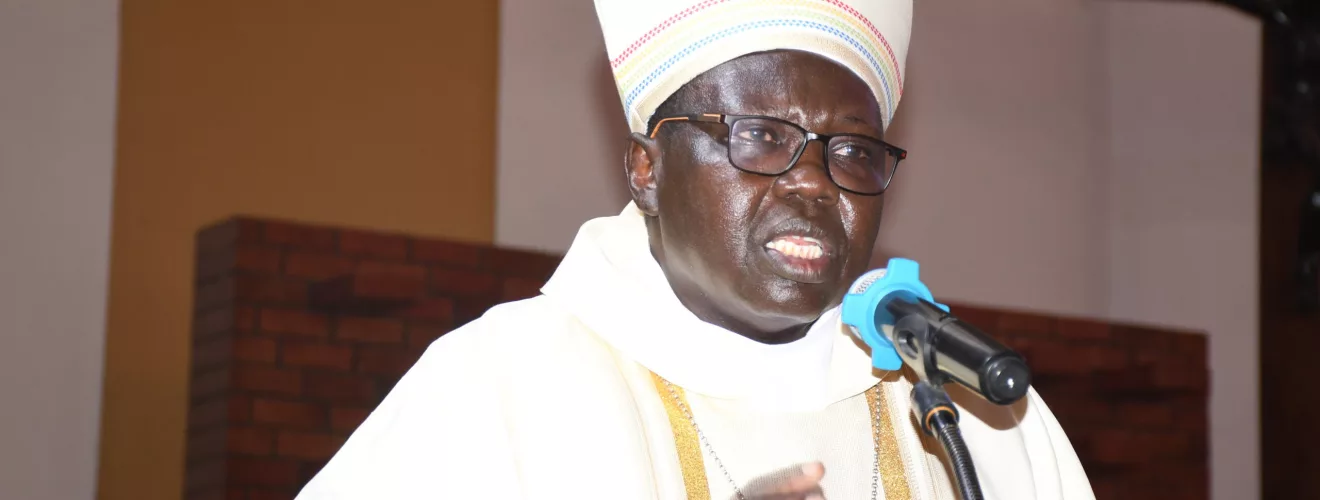
A Catholic bishop delivered a pointed public rebuke to South Sudan’s leaders on Sunday, calling on President Salva Kiir Mayardit and those in positions of authority to repent for what has been done to the nation, as the president sat in the congregation.
Bishop Santo’s Good Shepherd Sunday homily drew direct comparisons between the qualities of a just leader and the conduct of those he described as “bad shepherds” — leaders who, he said, starve and destroy their flocks, commit atrocities in villages and counties, drive people to suicide, and instruct citizens to eat reptiles, frogs, dogs, and lizards.
“Our leaders need to repent for what has been done to this nation,” the bishop said. “We must become a new people — saved by the sacrifice of Christ and by the willingness to care for one another.”
President Kiir was welcomed to the service at the start of the ceremony and was identified by name from the pulpit. Other senior dignitaries were also in attendance.
A Catalogue of Bad Leadership
The bishop framed the homily around the qualities of the Good Shepherd – a loving leader, a clear voice, and a tender heart – and used the biblical model as a standard against which to measure those who hold power.
some are even unknown to those they claim to lead, yet they force themselves upon them…
He described a bad shepherd as one who forces himself upon the people, is a stranger to those he claims to lead, and prioritises personal gain over service. He warned that “some are even unknown to those they claim to lead, yet they force themselves upon them.”
Going further, the bishop catalogued specific abuses: shepherds who “kill other shepherds, take away their sheep and cattle, and commit atrocities in different parts of our nations — in villages, counties, bomas, and payams.” He condemned leaders who tell struggling citizens to commit suicide and those who instruct people to eat animals not traditionally consumed by South Sudanese communities.
“These are examples of bad shepherds who should not be entrusted with responsibility,” he said. “They are selfish, careless, and greedy.”
A Direct Call for Political Repentance
Bishop Santo drew on the Acts of the Apostles to frame his political message in scriptural terms. Just as Peter told the early Christians to repent and be baptised, the bishop said South Sudan’s leaders must undergo a comparable transformation.
Our leaders need to repent for what has been done to this nation….
“Our leaders need to repent for what has been done to this nation,” he repeated, calling on those in power to become “new people” who care for citizens, for families, and for the institutions of state.
He also addressed the condition of ordinary South Sudanese, warning leaders not to add to the suffering of people who are “already frustrated, displaced, and suffering” — and who, he said, are increasingly being driven to take their own lives.
“Many people are committing suicide these days,” he told the congregation. “Do not add to their suffering. God is caring for His people, and He alone will lead us out of this situation.”
Setting Draws Attention to the Message
Bishop Santo is no stranger to controversy. He has developed a reputation as one of the few senior Church figures in South Sudan willing to address political failure from the pulpit, and has faced repeated calls – from within and outside the Church – to moderate his criticism of those in power. Sunday’s homily made clear he has not done so. If anything, the presence of the president in the congregation appeared to sharpen rather than soften his message.
The bishop specifically cautioned against false shepherds who use their position to harm rather than protect. “No Christian is permitted by God to kill another human being,” he said. “‘Do not kill’ is a commandment known from our earliest catechism.”
He closed his homily with a call for unity and shared listening: “We must listen to one another and to the voice of our Lord Jesus Christ, so that we become one flock with one shepherd.”
The president did not respond publicly to the homily’s content.